 VOICE-FIRST FIELD INSPECTION REPORTING
HAMI Voice was built around a very specific problem – keeping inspectors hands and eyes on the task in hand.
Inspectors know what they are looking at, they know what they want to say, but getting that information into a structured report can be a mission. It can mean stopping to type, scribbling notes to deal with later (if they can even read them that is), sometimes observing something – like access to an inspection object but not taking note of it for the next inspector, or finishing the job only to discover there is still another hour of reporting waiting for them.
So we built HAMI Voice to give them the software they needed to get the job done and done well. It saves time, which saves money and, in some cases, keeps them safer.
But this article isn’t about what HAMI was built for. It’s about how it’s evolved in our very own business.
HAMI Voice is now a regular part of our day to day at HAMI HQ
Now let’s be clear, we didn’t sit down and decide HAMI Voice needed to become a productivity app. It happened much more naturally than that. Someone needed to capture a conversation, another person wanted to get a collection of thoughts out of their head, and suddenly the software we had been demonstrating to inspectors was becoming part of how our own team worked.
Over the last couple of weeks, between London, Bangkok, Houston, Hamburgh and everything happening in between, that has made us look at HAMI Voice slightly differently.

It started on a random day, after a client meeting
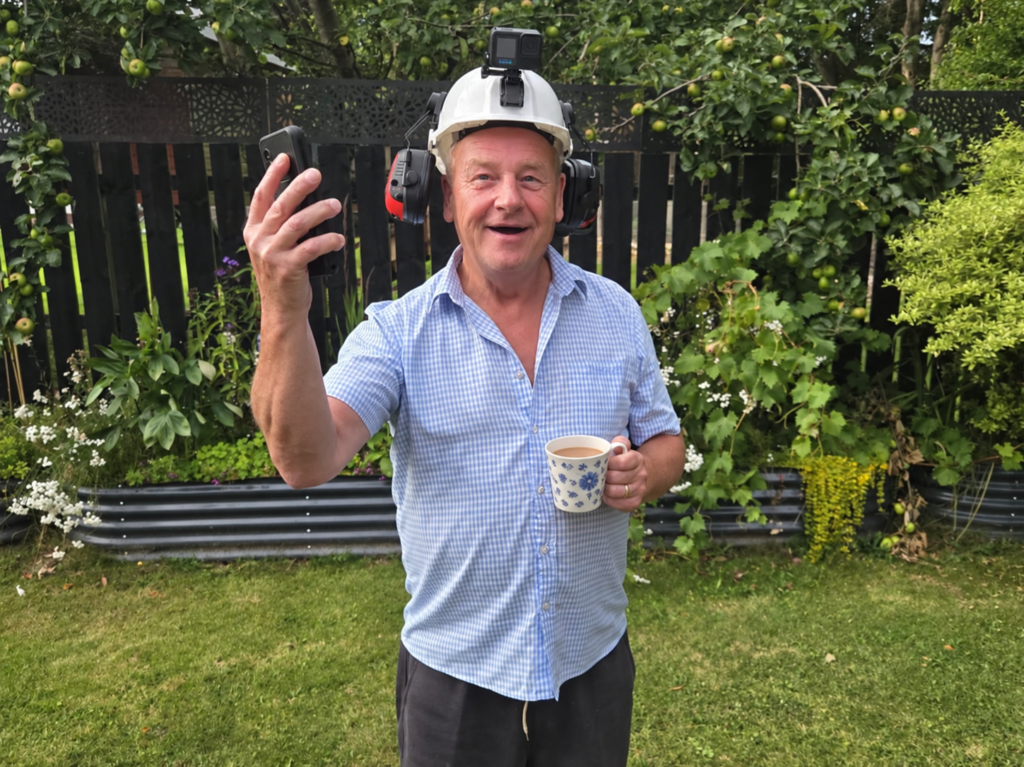
Client meetings can be long. They can be even longer if it means driving for several hours before you even arrive. So after long conversations and trading ideas, having to get home and sit down at your computer to get everything down on paper is just not something anyone wants to do. So instead, Inese took out HAMI and gave one of the templates all the information she had just gathered. Finalise. Create report. Done.
That report was now there with all the information from the day and ready to be sent to Becca to use for marketing content. Not only did it save hours, but it meant that Becca didn’t have to decipher incomplete sentences or ramblings from a very tired Inese.
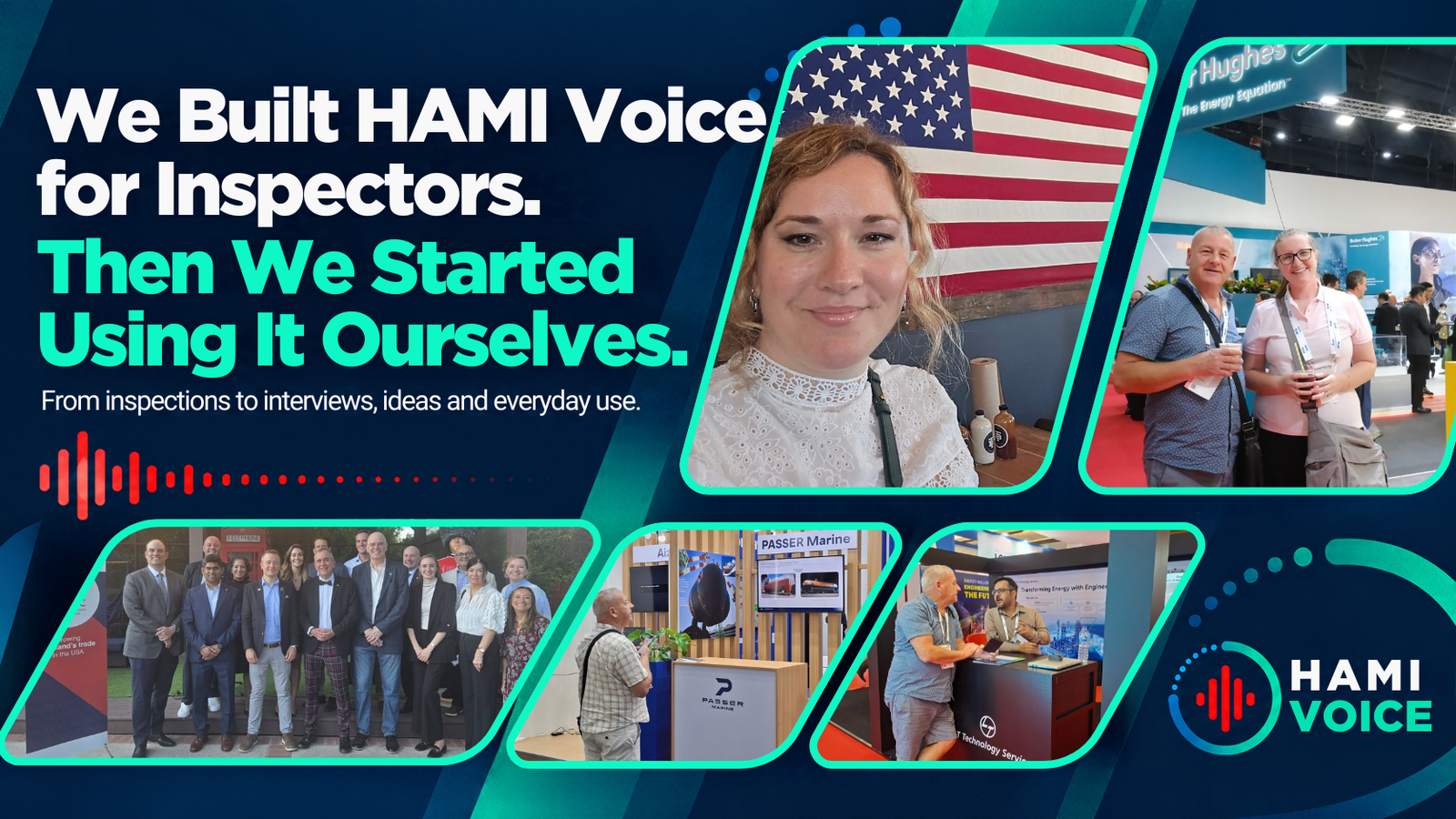
Then at Gastech we had plenty of opportunities to use HAMI in different ways. Completing interviews with potential clients, walking around taking our own notes, and we even got end of day reports from Inese on her time in Houston.
The structure was already there. Ask the questions, capture the answers and let the information fall into the right places.
That might not sound particularly revolutionary, but after several days of meeting dozens of people, the alternative is usually a combination of business cards, photographs, hurried notes and the optimistic belief that you’ll definitely remember who said what when you get back to the hotel.
You won’t. We know because we’ve tried.
Not too long before this…
Around the same time, we asked Inese to give us a Day in the Life piece for the HAMI Voice blog.
There was just one obvious problem.
She was too busy living the day to spend it documenting the day.
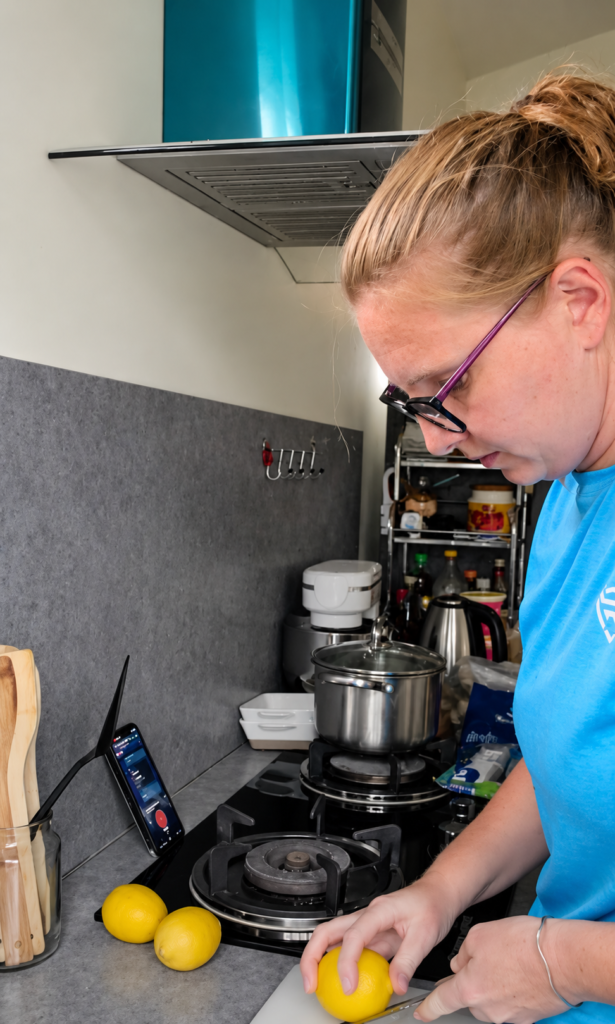
So the following morning, once she finally had a moment to sit down with breakfast and a coffee, she opened HAMI Voice and talked through what had happened.
The morning sales session. The customer meeting. Houston planning. School runs. Football. The dog walk. The ice cream.
Four voice entries later, HAMI Voice had produced a structured report that became the source material for the finished blog post.
We had built software to help inspectors get information out of their heads and into reports.
Apparently, it also worked rather well on CEOs.
If we’re honest, it could probably have taken a reasonable stab at writing the article too, but there are limits to how enthusiastically the marketing team is prepared to automate itself out of existence.

Houston continued the experiment
Inese then headed to Houston.
HAMI Voice was there for demonstrations, of course, but she also started using it to capture ideas, blog material and thoughts from the trip.
That was when the pattern became harder to ignore.
The value wasn’t necessarily tied to an inspection form.
The common problem was much broader: somebody knows what they want to say, but turning those thoughts into organised, usable information takes time.

Sometimes that person is an inspector describing corrosion.
Sometimes it’s somebody leaving a customer meeting who wants to capture what was discussed before half of it disappears from memory.
Sometimes it’s a CEO sitting with a coffee trying to reconstruct yesterday.
The subject changes, but the underlying problem doesn’t.
Maybe we were thinking about the category too narrowly
At Gastech, we had people immediately understand HAMI Voice as inspection software. Oil and gas was particularly obvious because surveys, inspections and formal reporting are such a significant part of the work.
Then people started suggesting other uses. Social housing came up. Meeting notes and minutes came up.
People we met socially started telling us how they would use it in their own work. Once that starts happening, you naturally begin looking at the product from a slightly different angle.
A teacher preparing annual pupil reports already knows the child they are describing. The time-consuming part is often turning a year’s worth of knowledge into organised written reports.
A shelter worker turning every things they know about a particular dog into a well worded adoption profile.
Someone leaving a business meeting may know exactly what was important but still has to turn a page of hurried notes into something other people can actually use.
None of these are inspection reports.
But all of them involve taking knowledge that already exists in someone’s head and giving it structure.
That’s essentially what HAMI Voice has been learning to do all along.
Does that mean we’re moving away from inspections?
No.
Inspection and field reporting remain some of the clearest use cases for HAMI Voice, and they are where much of the product has been developed, tested and challenged.
Working with inspectors has forced us to solve difficult problems around complex templates, repeatable sections, photographs, conditional logic, calculated fields, connectivity and reporting structures. Those environments have been an excellent place to build the technology because they leave very little room for software that only works under perfect conditions.
But building around a difficult use case doesn’t mean the technology has to remain there forever.
What we’re beginning to understand is that voice-first is less about an industry and more about an interaction.
If typing is the awkward part of the process, speaking may be easier.
If the information is already in your head, you shouldn’t necessarily have to spend another hour turning it into a document manually.
And if a piece of software can take natural spoken information and give it useful structure, there are probably more applications for that than we originally imagined.
The interesting part is what people do with it
Software companies are very good at telling customers exactly what their product is for.
We’re increasingly interested in the opposite.
Give somebody HAMI Voice, show them what it can do and see what problem they try to solve with it. Especially HAMI Lite.
That’s how some of the most useful ideas around the product have appeared already.
Someone looks at HAMI and says:
Could I use this for this?
Sometimes the answer is obvious. A clear cut yes or no.
Sometimes the answer is ‘we hadn’t thought of that actually.’
Those are usually the more interesting conversations.
It doesn’t mean every possible use case is suddenly becoming part of the HAMI Voice roadmap. There is a fairly large difference between spotting an interesting application and rebuilding your entire product around it.
But it does tell us something about the underlying technology and where it might have value.

Perhaps the simplest use case is just getting the thought out
There is also something much less grand going on here.
Not everything needs to become a new industry vertical.
Sometimes you just have something in your head that you need to get out.
People regularly say they struggle to articulate an idea when they sit down to write it. Yet ask them about the same subject in conversation and suddenly they have plenty to say.
That’s because talking and writing are different tasks.
HAMI Voice gives us an interesting bridge between the two.
You can speak naturally, without worrying about producing the perfect sentence as you go, and give the information a structure afterwards.
That principle works whether you are describing a subsea inspection or trying to remember what happened during an extremely busy Wednesday.
And yes, that means we’ve now used inspection software to help write blog posts about inspection software.
We’re comfortable with the irony.
We built HAMI Voice for a problem. The problem might be bigger than we thought.
The last few weeks haven’t made us abandon the original HAMI Voice vision.
They’ve made us look at it more carefully.
We started with a very clear problem: field professionals spending too much time turning what they already know into structured reports.
What we’re beginning to see is that inspectors aren’t the only people doing that.
The interesting part now is finding out where else the same principle genuinely saves time, rather than simply inventing use cases because we can.
Try it on for size
HAMI Voice has a 30-day free trial, so you don’t necessarily need to begin with one of our use cases.
Take something you already have to document and try doing it by speaking instead.
An inspection template, meeting notes, a report, an interview, or perhaps something we haven’t thought of yet.
See what happens when you stop worrying about writing it perfectly and simply start talking.
We’ll be interested to hear where you take it.