
 VOICE-FIRST FIELD INSPECTION REPORTING
When we started testing HAMI Voice with real inspection teams, we expected most of the feedback to centre around voice recognition. Was it accurate enough? Was speaking faster than typing? Would inspectors actually want to use voice once they were out in the field?
Those questions did come up, but seven pilot tests across subsea inspection, renewables, marine survey and NDT environments taught us something more useful.
Inspectors do not want voice to replace every way they already work. They want it to remove the parts of the job that slow them down.
That distinction has shaped how we think about HAMI Voice ever since.
Is voice better than pen and paper for field inspections?
Sometimes.
Voice is particularly useful when an inspector needs to capture detailed observations, measurements, comments or repeatable technical information while they are still carrying out the inspection. In those situations, stopping to write or type can interrupt the job itself.
For a short, familiar checklist, however, pen and paper can still be extremely efficient.
Our pilots showed us that the real opportunity is not replacing every pen, keyboard or touchscreen with voice. It is giving inspectors the right way to capture information at the right moment.
That is why we think of HAMI Voice as voice-first, not voice-only.
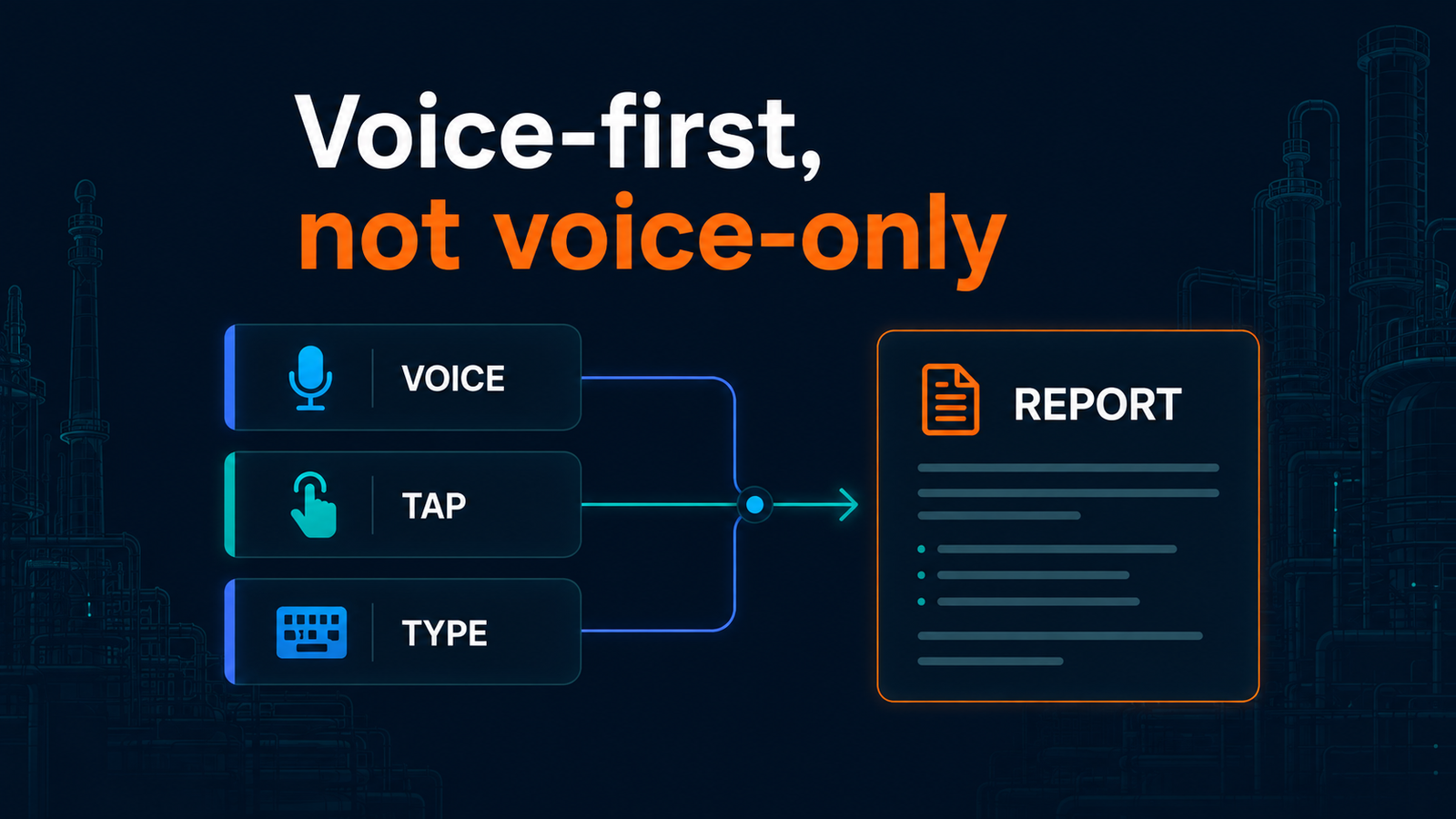
Lesson 1: Nobody wanted to speak everything
One of our assumptions going into the pilots was that inspectors using a voice-first system would probably want to speak their way through most of an inspection.
That was not what happened.
Different teams naturally developed different ways of working. Offshore teams tended to use voice for measurements and observations while typing certain coded fields. NDT technicians preferred to enter known job details before an inspection and then use voice for observations and comments. Marine surveyors used voice heavily while moving around a deck, then switched to typing when reviewing or editing information at a workstation.
Once we stopped looking at voice as a replacement for typing, the pattern made much more sense.
If an inspector is examining a component and needs to record an observation such as, “Coating breakdown on the lower flange, approximately 25 millimetres across,” saying it is often far easier than stopping to type it into a device.
If the answer is simply Pass, tapping the screen may still be quicker.
Lesson 2: Offline capability was non-negotiable
One question appeared almost immediately in nearly every pilot: What happens when there is no connectivity?
For teams working offshore, inside industrial facilities or in remote environments, poor connectivity is not unusual. It is part of the working environment.
During the original pilots, HAMI Voice’s offline workflow was based around secure capture. Inspectors could record their findings section by section without connectivity. Once a connection became available again, those recordings could be processed and the information structured back into the relevant parts of the report.
What surprised us was what inspectors valued most about that workflow. Real-time AI conversation sounded impressive, but knowing that their inspection data had been captured safely and would still be there when connectivity returned mattered more.
That became one of the clearest lessons from the pilots: in the field, reliability matters more than novelty.
What those offline lessons led to next
The original offline workflow solved an important problem, but it also raised another question.
If an inspector can safely capture information without connectivity, why should the useful interaction stop simply because the internet does?
That question has taken us considerably further down the rabbit hole.
Since those pilots, we have been developing and testing a standalone offline gateway that can interact with the user without relying on an internet connection. It is currently a separate R&D module rather than part of HAMI Voice, but it represents an important direction for the technology we are developing around field inspection.
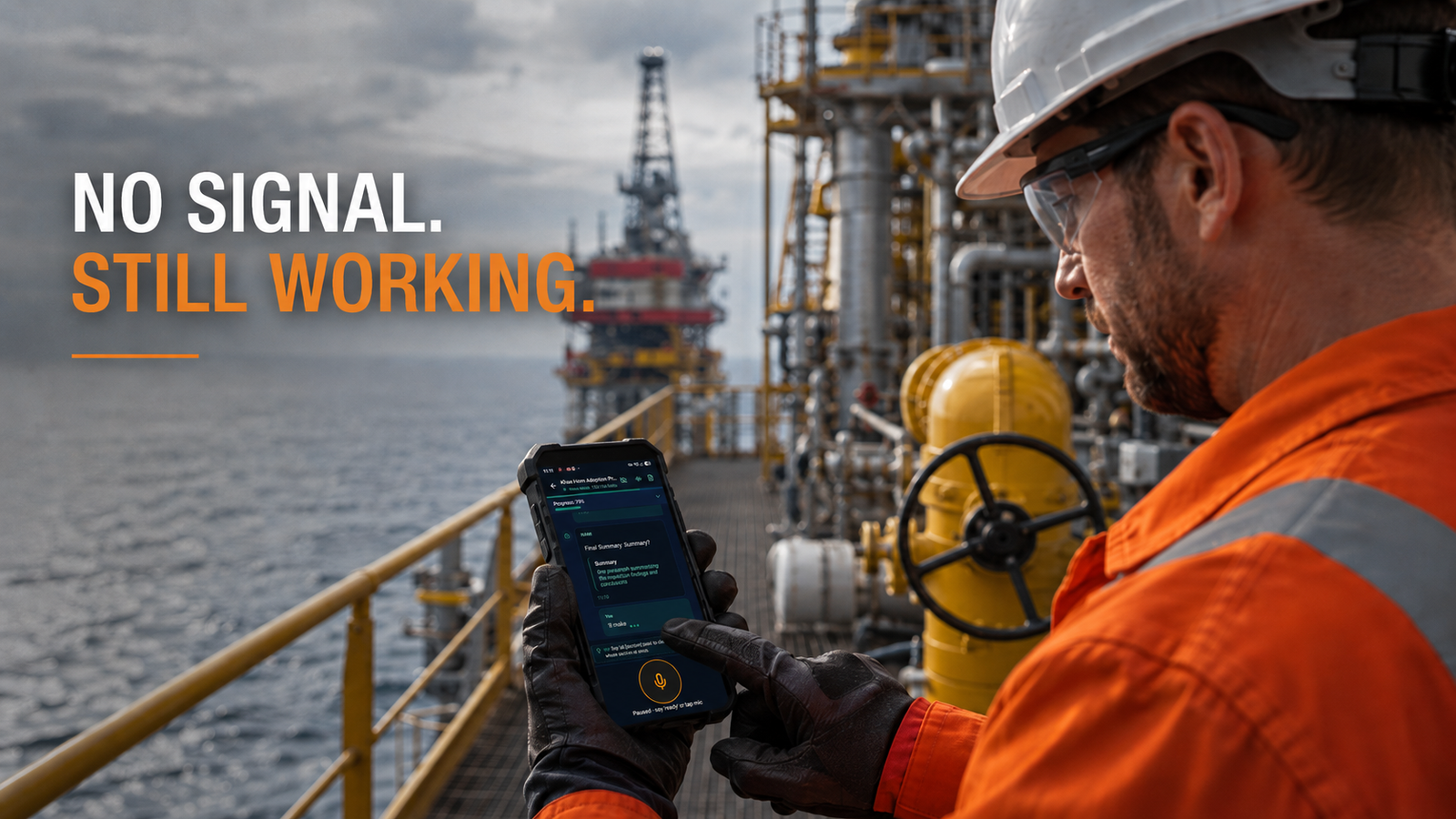
We are deliberately keeping the underlying technical approach to ourselves for now. What matters from the user’s point of view is much simpler: losing signal should not mean losing the workflow.
Testing on the devices people actually take into the field – that is another important part of the offline problem.
Building something that works on a high-spec laptop or flagship consumer phone is one thing. Getting it to work reliably on constrained industrial hardware is another.
With support from Andy Cooper at BARTEC, we have been able to test some of these ideas on industrial equipment rather than designing everything around ideal conditions.
That matters because if technology is intended for difficult industrial environments, including explosive atmospheres, those environments need to influence how it is built from the beginning. They cannot be something that gets considered once the software is already finished.
Lesson 3: We underestimated how important photographs would become
Photographs were not one of the biggest talking points before the pilots, but they quickly became one.
The problem was not necessarily taking inspection photographs. It was what happened afterwards.
In a traditional workflow, an inspector may take photographs throughout the job and then later need to work out which image relates to which defect, measurement, observation or report section. The images have to be identified, matched to the correct location and attached to the final report.
That creates another layer of administration after the inspection itself has finished.
Once inspectors realised they could capture a photograph during the inspection and associate it directly with the field they were already working on, the feature became much more important to them.
One pilot also resulted in another improvement: the ability to attach multiple photographs to a single field.
It is not necessarily the kind of feature that sounds revolutionary in a product demonstration, but when an inspector is dealing with dozens of photographs, removing that matching process later can make a meaningful difference.
Lesson 4: Pen and paper is not disappearing overnight
We build inspection software, but we are not going to pretend paper is inefficient in every situation.
Several inspectors told us that some familiar forms are genuinely quicker to complete by hand. A short checklist containing simple Pass/Fail or Yes/No answers can be extremely efficient on paper, particularly when somebody has completed the same form hundreds of times.
Turning that into a lengthy voice interaction just for the sake of digitising it would not be progress.
The calculation changes when the inspection becomes more complex.
A multi-section technical report may include measurements, detailed observations, conditional questions, photographs, comments, repeatable information and a formal report that still needs to be produced afterwards. Those are the workflows where voice-first reporting starts to become particularly useful.
They are also where the hidden reporting time begins to appear.
An inspection might take two hours, followed by another 45 minutes writing up the report. Handwritten notes might need to be passed to somebody onshore because the final report needs to be typed. Photographs may still need to be matched to individual observations.
The inspection is finished, but the work is not.
That gap between carrying out the inspection and producing the finished report is where we see some of the greatest opportunity.
What about repetitive checklists?
Even with simpler inspection forms, the answer is not necessarily to abandon voice altogether. The workflow just needs to be sensible.
One improvement we made allows a user to deal with an entire section rather than being forced through every individual field. If everything within a section has passed, for example, the inspector can record that at section level rather than answering the same type of question repeatedly.
The objective is not to maximise the amount of voice being used. It is to minimise unnecessary work.
Those are very different goals.
Lesson 5: The sceptics gave us some of our best feedback
Some of the most useful people in the pilots were the inspectors who were not immediately convinced.
One inspector told us plainly that he did not need HAMI Voice. After using it, he came back interested in the conditional fields feature because he had realised it could remove around 12 irrelevant N/A responses he was manually entering every day.
That is exactly the kind of feedback we want from a field trial.
Across the pilots, a similar pattern appeared repeatedly. Initial scepticism was followed by one or two moments where a particular feature solved a very specific irritation. Once that happened, the questions started.
Could the system handle a section differently? Could another photograph be added here? Could a field disappear automatically when a previous answer made it irrelevant?
That is when a pilot becomes useful.
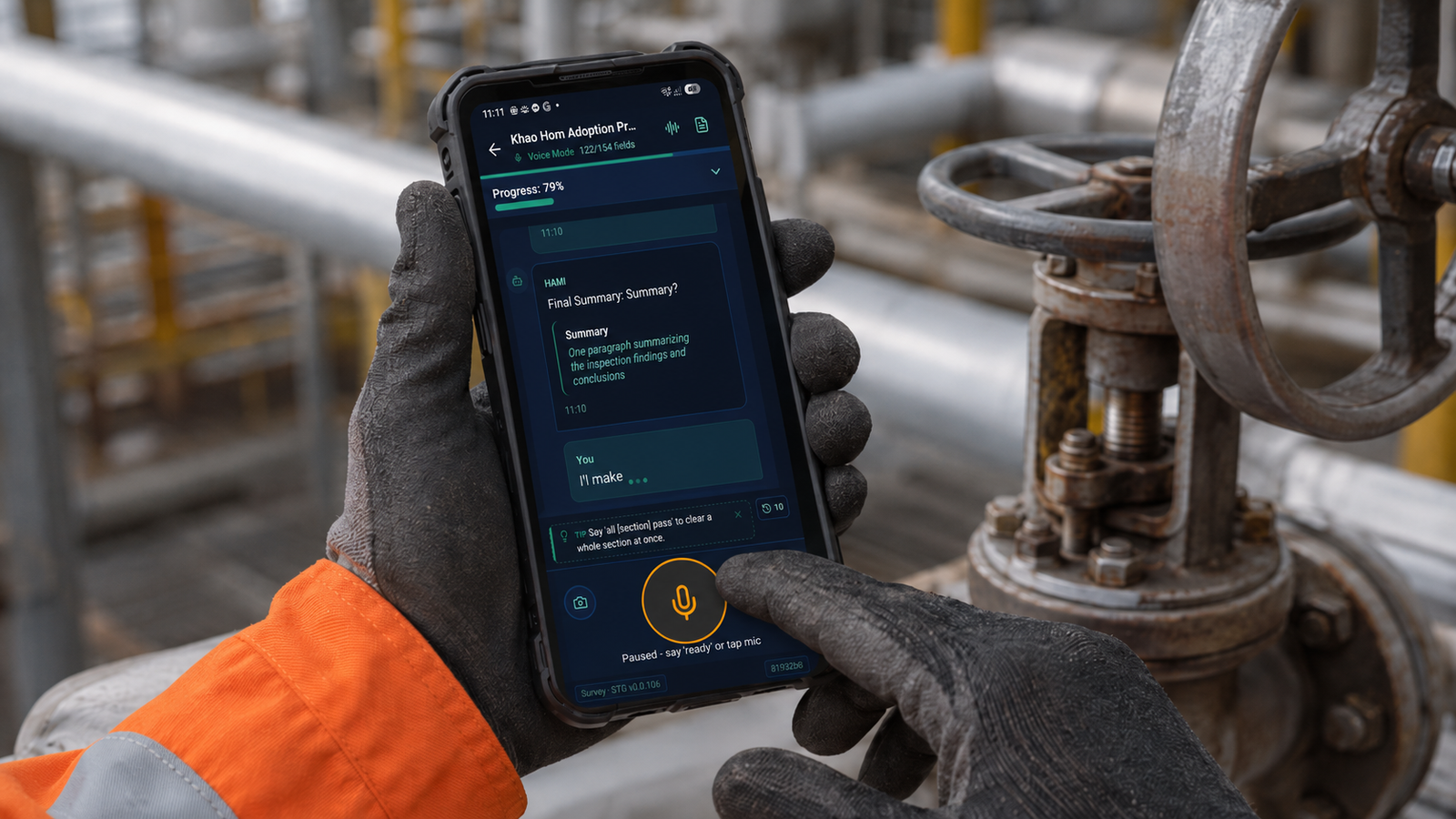
A good field trial is not about getting inspectors to tell you that the product is brilliant. It is about letting the people who actually do the job show you where the workflow still needs to improve.
So, is voice replacing pen and paper in field inspections?
No, and we do not think that should be the goal.
Pen and paper can still work extremely well for simple, repetitive tasks. Typing remains useful for known information, codes and quick edits. Voice becomes particularly valuable when someone needs to capture detailed information while they are also inspecting, measuring, observing, photographing or moving around an asset.
That means less retyping, less duplicated information, less matching evidence afterwards and fewer interruptions to the inspection itself.
Seven pilot tests did not convince us that voice should replace everything. They taught us something more useful: inspection technology works best when it adapts to the way inspectors actually work, rather than forcing inspectors to adapt to the software.
That principle continues to shape HAMI Voice and the wider technology we are now developing around it.
Try HAMI Voice on a real inspection
The best way to decide whether voice-first reporting works for your team is not to watch a perfect demonstration using a carefully prepared example form.
Use one of your own.
Take an inspection template your team already works with and try it in the environment where the job actually happens.
HAMI Voice is available with a 30-day free trial, with no credit card required. You can also book a demo and work through one of your existing inspection templates with us.


0 Comments